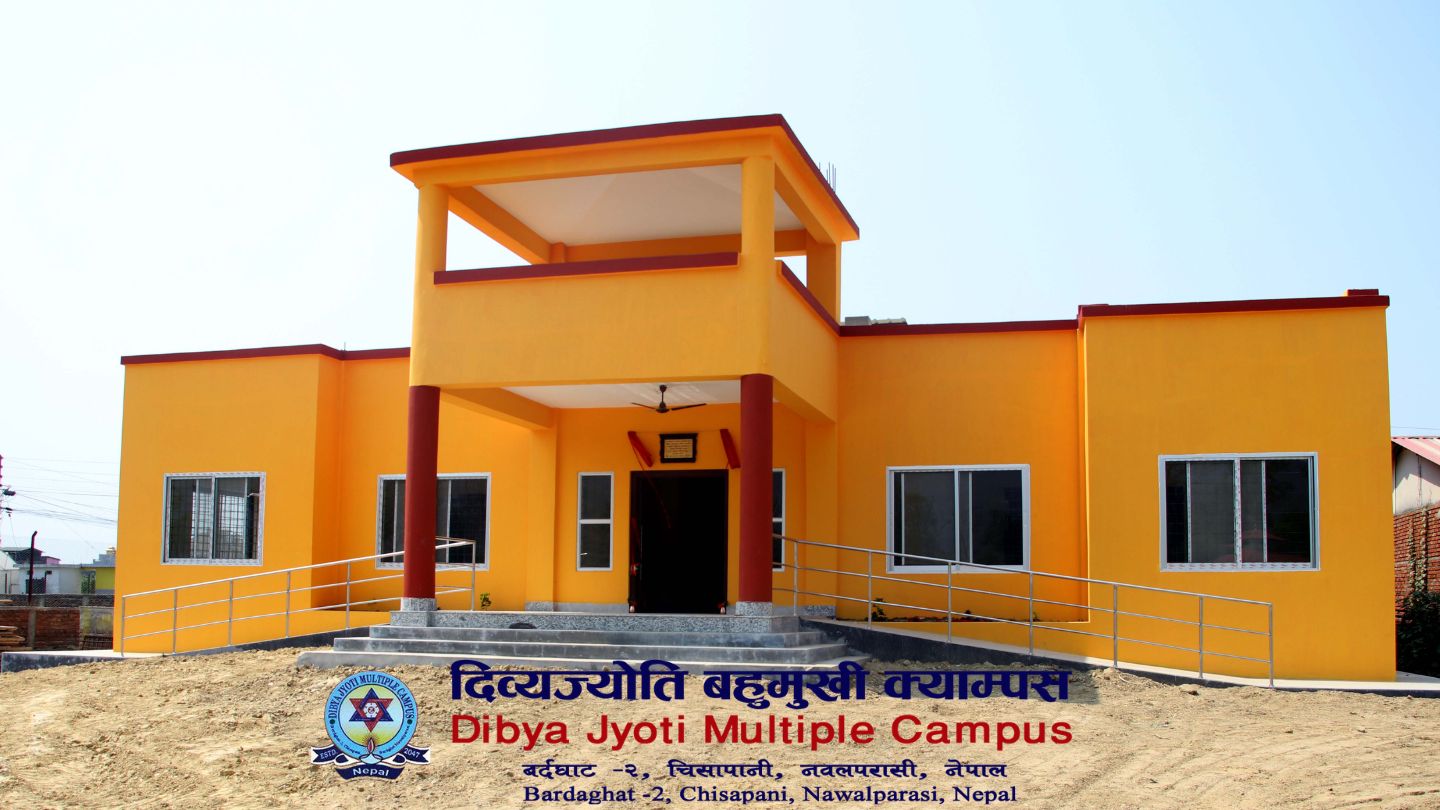
The Master of Education (M.Ed.) at Dibya Jyoti Multiple Campus is a master’s level program offered under Tribhuvan University. The program began at the campus on 14/10/2067 B.S. (28/01/2011). Located at Bardaghat-2, Chisapani, Nawalparasi (Bardaghat Susta West), Lumbini Province, the campus runs M.Ed. within a community-based academic setting that also offers bachelor’s and master’s study in education, management, and humanities.
At Dibya Jyoti Multiple Campus, the M.Ed. specialization areas are Nepali and Educational Planning and Management (EPM). The program follows the semester system and combines core education courses, specialization study, practical work, and thesis writing within a campus environment that supports library use, technology-friendly classrooms, and discussion-based teaching.
College: Dibya Jyoti Multiple Campus
Affiliation: Tribhuvan University
Program: Master of Education (M.Ed.)
Duration: 2 years
Academic structure: 4 semesters
Total credit hours: 69
Program commencement at the campus: 14/10/2067 B.S. (28/01/2011)
Campus specialization areas: Nepali and EPM
Program components: Core courses, specialization courses, practical work, and thesis
The M.Ed. is a four-semester program designed for advanced study in education. It combines professional education courses with specialization-based learning and research work.
The program structure includes:
21 credit hours of core courses
39 credit hours of specialization courses
3 credit hours of Teaching Practice or Practicum
6 credit hours of Thesis Writing
Core courses include Foundations of Education, Advanced Educational Psychology, Curriculum Practices, Education and Development, Research Methodology in Education, Measurement and Evaluation in Education, and Contemporary Educational Issues. In the fourth semester, students complete practical work and thesis writing. For Educational Planning and Management, the practical component is organized as practicum.
Prepare qualified teachers for upper high schools
Develop educational planners, administrators, managers, supervisors, and other educational professionals
Strengthen advanced knowledge in education policy, pedagogy, and research
Support specialization-based academic and professional growth
Connect theory, research, and practice in the field of education
The M.Ed. is suited to students who want postgraduate study in education after completing B.Ed. or related teacher education qualifications. Its semester structure supports advanced academic work, specialization study, and research-based learning.
At Dibya Jyoti Multiple Campus, the program operates within an education stream that also includes B.Ed. This creates an academic setting where students can continue higher study in education within the same institution. The campus environment also adds scholarship support, teacher training activity, technology-friendly classrooms, and a teaching-learning process that includes lectures, discussion, and applied academic work.
Build advanced understanding of education, pedagogy, and educational research
Develop academic competence in a chosen specialization area
Strengthen research, analysis, and presentation skills
Apply theory in teaching practice or practicum
Complete thesis-based academic work under supervision
Educational research and thesis writing
Seminar and presentation work
Project and assignment-based learning
Case studies and field studies
Specialization-focused academic training
Teaching practice or practicum
The M.Ed. uses a semester-based teaching approach that combines classroom instruction with research and practical learning activities. Course delivery includes lectures as well as applied academic methods.
Lecture sessions
Project works
Assignments
Seminar
Case studies
Field studies
Group discussion
Presentation-based learning
Digital classroom support
Upper high school teaching
Educational planning and management roles
Academic and administrative work in education
Supervision and educational support roles
Research-related academic pathways
Scholarships for Dalit students
Scholarships for women students
Scholarships for Indigenous nationalities
Support for low-income students
Scholarships for meritorious students
Fee concessions based on internal and annual results
UGC, provincial, and local-level scholarship support
TU-affiliated M.Ed. program in a community campus setting
M.Ed. available at the campus since 2011
Specialization options in Nepali and EPM
Semester-based structure with thesis and practical component
Library and technology-friendly classroom support
Scholarship and fee-support provisions for different student groups
Higher study environment linked with the campus B.Ed. program
The campus publishes the admission notice for M.Ed. intake
Applicants submit the prescribed application with personal and academic details
General eligibility includes B.Ed. or Post-Graduate Diploma in Education from TU or a recognized university
For Nepali specialization, applicants may apply with B.Ed. major or minor in Nepali Education, or BA major in Nepali with one-year B.Ed.
For EPM specialization, applicants may apply with B.Ed. in any discipline, or BA/BSc with one-year B.Ed.
Selection is based on marks obtained in the entrance examination related to educational aptitude and specialization subject knowledge
Final admission is completed after document submission and fee payment
Bachelor’s degree transcript
Bachelor’s degree certificate or provisional certificate
Character certificate
Migration certificate if applicable
Transfer certificate
Citizenship certificate or birth certificate copy
Passport-size photographs
Entrance-related record if required
Completed admission form
Admission fee payment receipt
The M.Ed. follows the semester system. Internal evaluation carries 40 percent of the total mark of each subject, and students appear in semester-end examinations conducted by the Office of the Dean. Teaching Practice or Practicum and Thesis are practical components. Their final examination process is handled through the Dean’s Office of the Faculty of Education.
The M.Ed. at Dibya Jyoti Multiple Campus offers postgraduate study in education within an established community-campus setting in Bardaghat. With its four-semester structure, specialization options in Nepali and EPM, research-based learning, and thesis component, the program provides a clear route for students seeking advanced study in education under Tribhuvan University. The campus setting adds academic continuity, student support, and a teaching environment linked to both classroom learning and practical work.
The M.Ed. is a 2-year program completed in 4 semesters.
The M.Ed. program began at the campus on 14/10/2067 B.S. (28/01/2011).
The campus offers M.Ed. in Nepali and Educational Planning and Management (EPM).
The M.Ed. carries 69 credit hours in total.
The structure includes 21 credit hours of core courses, 39 credit hours of specialization courses, 3 credit hours of Teaching Practice or Practicum, and 6 credit hours of Thesis Writing.
Applicants with B.Ed. or Post-Graduate Diploma in Education from TU or a recognized university can apply, along with the required subject-specific eligibility for the chosen specialization.
The program follows the semester system with 40 percent internal evaluation and semester-end examinations conducted by the Office of the Dean.