



Bachelor of Public Health (BPH) at Central Institute of Science and Technology College (CIST College), Sangam Chowk, New Baneshwor, Kathmandu, is a four-year undergraduate program affiliated with Pokhara University. The program is structured across eight semesters and requires 145 credit hours.
BPH combines basic health sciences, public health sciences, epidemiology, research methods, public health management, health promotion, community work, laboratory learning, and field practice. The curriculum gradually moves from foundational health sciences to disease prevention, community assessment, health-system management, research, and a final public health dissertation.
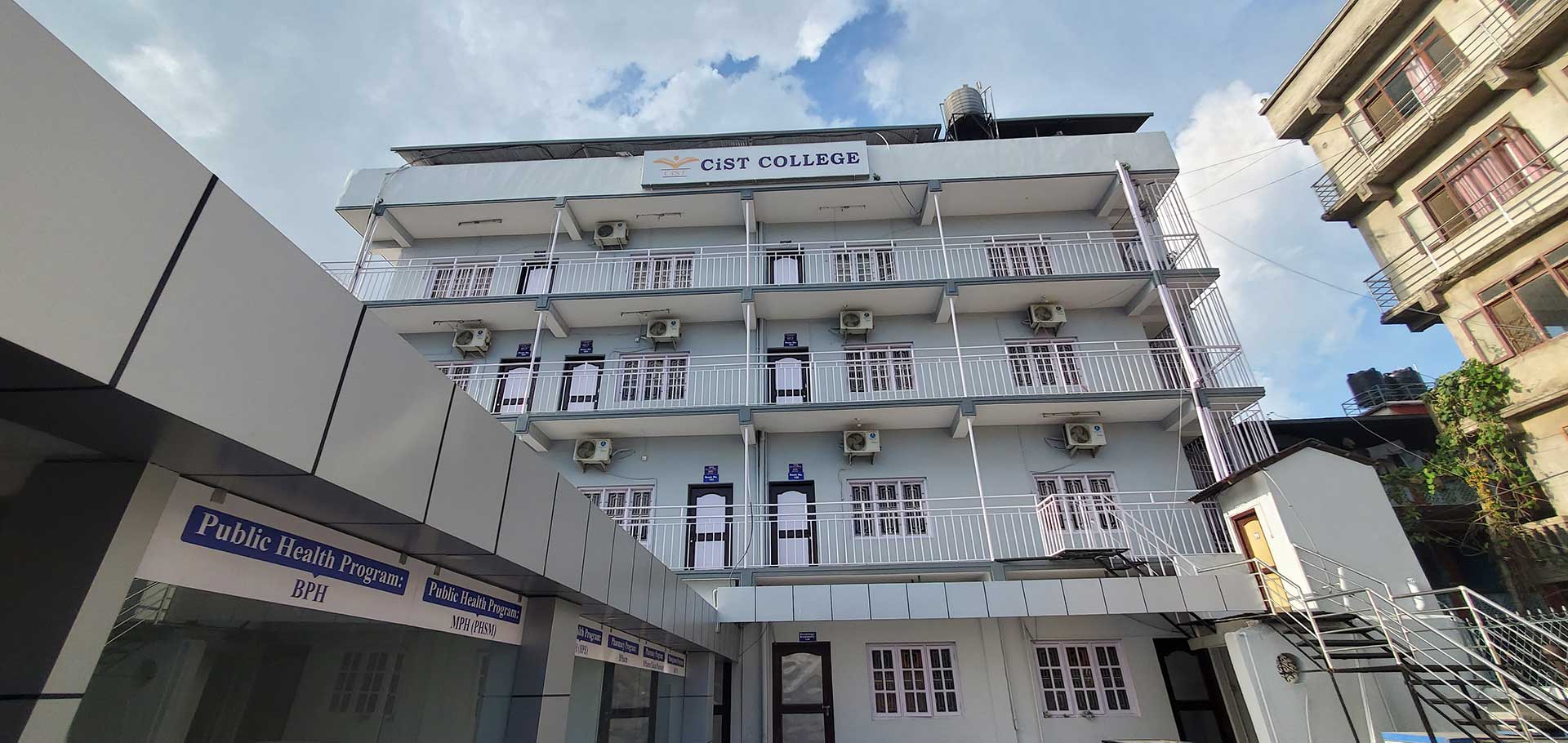
| Particular | Details |
|---|---|
| Course | Bachelor of Public Health (BPH) |
| Level | Bachelor's |
| Institution | CIST College |
| Location | Sangam Chowk, New Baneshwor, Kathmandu |
| Affiliation | Pokhara University |
| Faculty | Faculty of Health Science |
| Duration | 4 years / 8 semesters |
| Total Credit Hours | 145 |
| Theory Credits | 108 |
| Practical / Field Credits | 37 |
| Seats | 40 |
Pokhara University's BPH curriculum is organized around six academic strands:
Basic Health Sciences
Public Health Sciences
Public Health Tools and Methods
Public Health Intervention
Public Health Management
Supporting Skills and Public Health Application
The early semesters establish an understanding of human health, biological sciences, environmental factors, disease processes, nutrition, and basic public health concepts. Middle semesters move into epidemiology, health behavior, community health, health promotion, statistics, and public health interventions. The later part of the program concentrates on management, research, health systems, field practice, policy, law, and dissertation work.
The BPH curriculum is designed to develop academic and practical competence across major public health areas.
Its objectives include developing knowledge and skills in:
Applied public health sciences
Primary health and health-system development
Epidemiology
Public health research
Public health management
Health economics
Nutrition
Environmental health
Human resource development in health
Community diagnosis
Scientific writing
Field-based public health practice
Research methods, term work, community practice, and dissertation preparation are incorporated into the degree rather than being treated as separate activities outside the curriculum.
Eligibility: Applicants may enter the BPH admission process after completing one of the stated qualifying academic routes, including:
10+2 Science with Biology
PCL Science with Biology
PCL or Diploma in Health Sciences
An equivalent qualification recognized for admission
The stated academic requirement includes a minimum 50% aggregate in the qualifying examination.
Under the grading system, the stated requirement includes:
Minimum CGPA of 2.4 in aggregate
Minimum C+ grade in Physics, Chemistry, and Biology
Minimum C grade in other subjects
Health Science Proficiency Certificate or Diploma applicants under the applicable pathway must satisfy the relevant academic and professional registration requirements.
BPH is one of the undergraduate health science programs whose admission falls under the prevailing medical education admission framework of the Medical Education Commission (MEC), Nepal.
Applicants must participate in and qualify through MECEE-BL for admission under the applicable rules.
Admission follows the prevailing MEC provisions relating to:
Eligibility
MECEE-BL qualification
Merit
Matching
Seat allocation
Scholarship provisions
Fee structure
Admission procedures
Code of conduct
Examination guidelines
Official admission calendar
Seats, fees, scholarships, examination provisions, and admission procedures may change according to MEC decisions for a particular admission year.
CIST College has a stated BPH intake of 40 seats. For MEC-regulated programs, the final number applicable to an admission cycle is subject to the annual seat determination.
The BPH program carries 145 credit hours across eight semesters. Of these, 108 credits are theory courses and 37 credits are laboratory, practical, field-practicum, seminar, and dissertation components.
The first semester carries 19 credits and establishes the basic scientific and public health foundation.
Students study:
Introduction to Public Health-I
Anatomy and Physiology
Biochemistry
Microbiology and Immunology
Professional English
Anatomy and Physiology Lab
Biochemistry Lab
Microbiology and Immunology Lab
Professional English Practical
The second semester carries 20 credits and continues the basic health science foundation through:
Environmental Science
First Aid
Nutritional Science
Parasitology and Entomology
Pharmacy, Pharmacology and Toxicology
Each subject is accompanied by the relevant laboratory or practical course.
The third semester carries 20 credits and moves more directly into population and community health.
The courses are:
Communicable Diseases
Environmental Health
Non-communicable Diseases
Public Health Nutrition
Reproductive Health and Demography
Integrated Concurrent Field Practice I
Integrated Concurrent Field Practice I begins structured community exposure. Students work with community information, household-level activities, public health assessment, data collection, analysis, presentation, and reporting.
The fourth semester also carries 20 credits.
Students study:
Basic Epidemiology
Introduction to Public Health-II
Public Health Behavior and Anthropology
Maternal, Child and Elderly Health
Occupational Health and Safety
Integrated Concurrent Field Practice II
The fifth semester carries 20 credits and introduces a stronger management, epidemiology, behavioral science, and statistical component.
Courses include:
Basic Public Health Management
Health Promotion and Education
Epidemiological Methods and Management
Public Health Sociology and Social Psychology
Public Health Statistics-I
Integrated Concurrent Field Practice III
The three Integrated Concurrent Field Practice courses connect learning across successive semesters and develop practical skills in community assessment, health promotion planning, implementation, evaluation, data handling, presentation, and report preparation.
The sixth semester carries 18 credits.
Students study:
Community Health Diagnosis and Program Implementation Strategies
Public Health Statistics-II
Health System Management in Nepal-I
Health Finance and Health Economics Including Entrepreneurship
Health Education Communication
Residential Field Practice in Community Health Diagnosis
This semester places community diagnosis alongside health-system, economic, statistical, and communication subjects.
The seventh semester carries 15 credits.
Courses include:
Health Research Methodology
Human Resource Development and Management
Health Monitoring and Evaluation
Health System Management in Nepal-II
Residential Field Practice in Comprehensive Health Management
The curriculum at this stage moves into organizational management, monitoring, evaluation, health-system analysis, research preparation, and residential field practice.
The final semester carries 13 credits and contains:
Disaster Management
Public Health Policies, Laws and Acts
Journal Club / Health Seminar
Public Health Dissertation
The dissertation carries 6 credits.
Fieldwork is built into the BPH curriculum over several semesters rather than being concentrated only at the end of the degree.
The field components include:
Integrated Concurrent Field Practice I
Integrated Concurrent Field Practice II
Integrated Concurrent Field Practice III
Residential Field Practice in Community Health Diagnosis
Residential Field Practice in Comprehensive Health Management
Public Health Dissertation
These activities develop experience in community entry, rapport building, health assessment, data collection, analysis, intervention planning, community presentation, program work, report preparation, and public health management.
The final-semester Public Health Dissertation is a field-based research component carrying 6 credits.
Students work under faculty supervision through proposal development, field research, data handling, analysis, report preparation, presentation, and dissertation defense.
The dissertation requires 48 hours of consultation with the supervisor and 180 hours of field activity, including data entry. The field component is planned over approximately four to five weeks.
The research process includes:
Identifying and prioritizing a public health problem
Developing a research proposal
Preparing research tools
Completing the required ethical approval process
Collecting and processing data
Analyzing and interpreting findings
Writing the dissertation
Presenting research findings
CIST College provides academic facilities relevant to BPH study, including a library with books, journals, reports and electronic resources, computer facilities, classrooms with audio-visual teaching aids, and public health-related laboratory spaces.
Relevant laboratory areas include:
Public Health
Anatomy
Physiology
Microbiology
Biochemistry
First Aid
Nutrition
Environmental Health
Health Education and Communication
These facilities correspond with the laboratory and practical courses concentrated in the first years of the BPH curriculum and the field-oriented public health courses that follow.
BPH students are evaluated through both internal and external assessment.
Internal evaluation: 50%
Semester-end external examination: 50%
Internal assessment may include quizzes, tutorials, laboratory work, assignments, class tests, participation, term papers, and internal examinations.
Students must pass the internal and external components independently. A student who does not meet the minimum internal requirement receives NOT QUALIFIED (NQ) status and cannot sit for the semester-end examination in that course.
Pokhara University uses a letter-grade system ranging from A to F. A grade of D is the minimum passing requirement in an individual course.
To complete the BPH degree, a student must:
Obtain D or better in every required subject.
Complete all required courses and the dissertation.
Complete the degree within the permitted study period.
Maintain a final CGPA of at least 2.00.
The normal duration is four years or eight semesters, while the maximum period allowed for completion is eight years.
A CGPA of 3.6 or above qualifies for the BPH degree with distinction, while a CGPA of 3.7 or above meets the stated Dean's List standard.
The BPH curriculum identifies several areas in which graduates may pursue further professional development or employment, including:
University education and research
Public health organizations
Government, NGO, and private health organizations
Health-related consultancy agencies
Self-employment and entrepreneurial activity
These are possible career areas rather than guaranteed job outcomes. Employment depends on professional registration, academic performance, experience, organizational requirements, available positions, and other applicable conditions.
Completion of the BPH degree and professional practice are separate stages.
Graduates entering regulated public health practice must pass the applicable professional council licensing examination and complete the required registration process.
For BPH graduates, the relevant professional body is the Nepal Health Professional Council (NHPC).
CIST College provides scholarship opportunities under applicable rules, while scholarship arrangements for MEC-regulated health science admissions also follow prevailing Medical Education Commission provisions.
The stated BPH intake is 40 seats. Since the program falls within the MEC admission framework, the final seat allocation, scholarship distribution, fee provisions, and admission arrangements applicable to an intake may vary according to the annual MEC decision and calendar.
BPH stands for Bachelor of Public Health.
Duration: The program runs for four years across eight semesters. The curriculum contains 145 credit hours.
The BPH program at CIST College is affiliated with Pokhara University.
CIST College has a stated BPH intake of 40 seats. The final number for an admission cycle is subject to the applicable MEC seat determination.
Yes. BPH is included among the undergraduate health science programs requiring participation in and qualification through MECEE-BL under the prevailing Medical Education Commission admission framework.
Students must complete 145 credit hours, consisting of 108 theory credits and 37 practical, field, seminar, and dissertation credits.
Yes. The curriculum includes three Integrated Concurrent Field Practice courses, residential field practices in Community Health Diagnosis and Comprehensive Health Management, and field-based dissertation work.
Yes. Public Health Dissertation is a 6-credit course in the eighth semester.
Students must complete all required courses and the dissertation with a final CGPA of at least 2.00.
Yes. Graduates entering regulated professional practice must complete the applicable professional council licensing and registration requirements.





.png)





