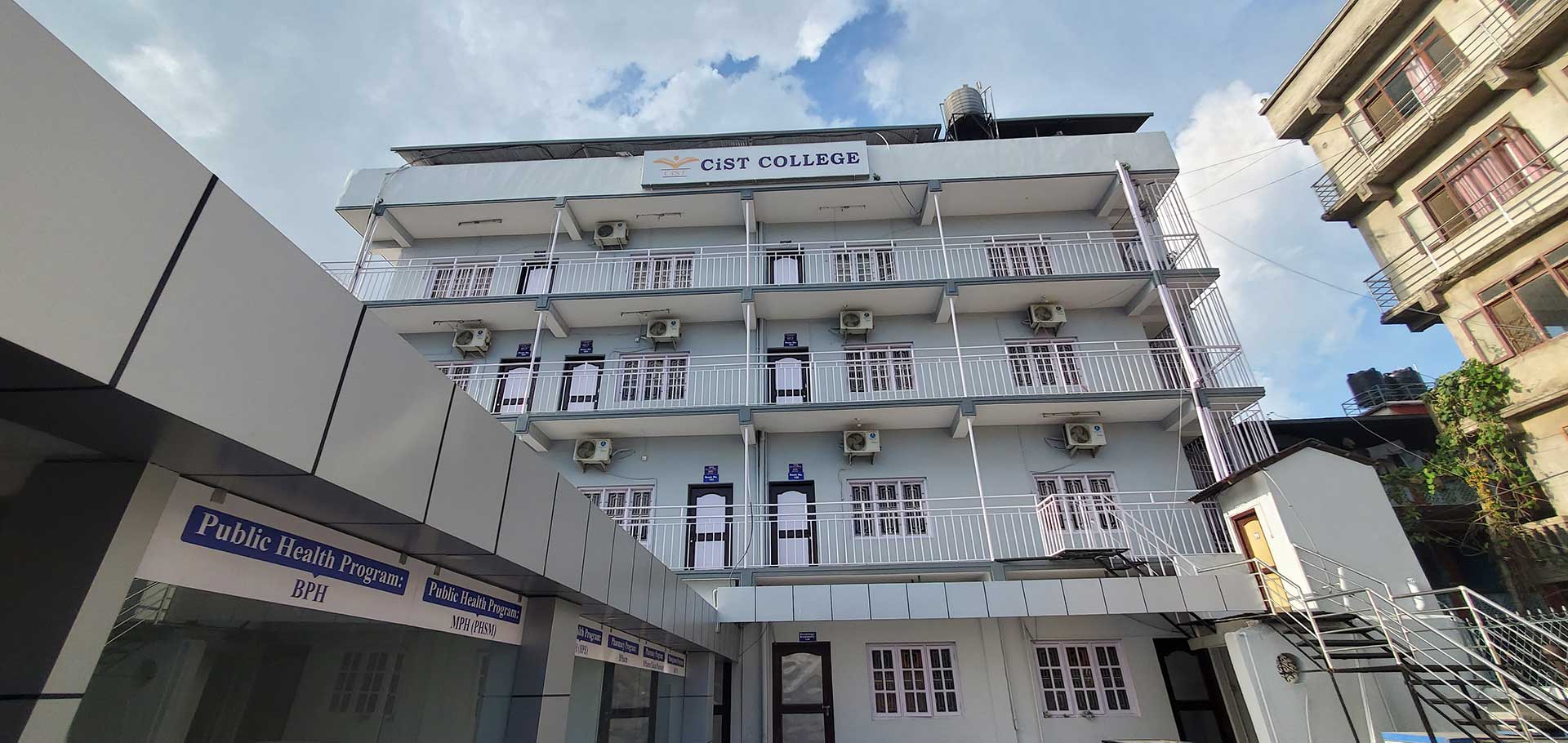
Bachelor of Pharmacy (B Pharm) at Central Institute of Science and Technology College (CIST College), Sangam Chowk, New Baneshwor, Kathmandu, is a four-year undergraduate pharmacy program affiliated with Pokhara University. The course runs across eight semesters and combines pharmaceutical science, health science, laboratory work, pharmacy practice, seminars, and research.
The academic progression begins with pharmaceutics, chemistry, anatomy, physiology, pharmacognosy, mathematics, and basic laboratory work. Later semesters move into pharmacology, medicinal chemistry, pharmaceutical microbiology, biopharmaceutics, industrial pharmacy, hospital and community pharmacy, clinical pharmacy, pharmacotherapeutics, pharmaceutical management, professional law, and research.
| Particular | Details |
|---|---|
| Course | Bachelor of Pharmacy (B Pharm) |
| Level | Bachelor's |
| Institution | CIST College |
| Location | Sangam Chowk, New Baneshwor, Kathmandu |
| Affiliation | Pokhara University |
| Duration | 4 years / 8 semesters |
| Academic Area | Pharmaceutical Sciences |
| Seats | 40 |
CIST College has a stated intake of 40 seats for B Pharm. As the program falls within Nepal's regulated medical education admission framework, the seat number applicable to an admission year is subject to the prevailing determination of the Medical Education Commission.
B Pharm connects chemical and pharmaceutical sciences with human health and the practical use of medicines. Its curriculum covers the preparation and formulation of medicines, pharmaceutical analysis, biological sciences, pharmacology, natural medicines, industrial production, quality assurance, hospital and community pharmacy, clinical pharmacy, and professional pharmacy practice.
The program also includes repeated laboratory courses and pharmaceutical seminars. In the later semesters, students encounter research methodology and research project work alongside pharmacy practice.
The academic objectives include preparation for pharmacy practice, strengthening pharmacy knowledge through education and training, contributing to pharmaceutical research and publications, and supporting pharmaceutical and related organizations through professional knowledge.
Eligibility: One stated admission pathway requires applicants to have completed 10+2 Science in the Biology group or an equivalent qualification with:
At least 50% separately in Physics, Chemistry, and Biology, with 50% aggregate marks; or
At least C+ grade separately in Physics, Chemistry, and Biology, at least C grade in the remaining individual subjects, and a GPA of 2.4; or
An equivalent academic standard under another grading system, including applicable certificate-level qualifications.
Applicants from specified Health Science Proficiency Certificate Level programs may also qualify with at least 50% aggregate marks. The listed PCL backgrounds include:
General Medicine
Medical Laboratory Technology
Ophthalmic Science
Dental Science
Pharmacy
Applicants entering through an applicable health science qualification must meet the corresponding professional council registration requirement.
Pokhara University's broader health science admission criteria also place B Pharm among programs requiring a science or qualifying health-science background and the applicable Medical Education Commission entrance process.
Admission to B Pharm follows the prevailing undergraduate medical education framework of the Medical Education Commission (MEC), Nepal.
Candidates must participate in and qualify through MECEE-BL under the rules applicable to the admission cycle.
The admission framework includes the prevailing provisions concerning:
Academic eligibility
MECEE-BL qualification
Merit
Matching
Seat allocation
Scholarship provisions
Fee structure
Admission procedures
Code of conduct
Examination-related requirements
MEC admission calendar
Seats, fees, scholarship arrangements, and admission procedures may change according to MEC decisions for the relevant academic year.
The four-year curriculum is arranged in a sequence that moves from foundational sciences and pharmaceutics toward applied pharmaceutical science, hospital and clinical pharmacy, professional practice, and research.
Major courses and practical areas include:
Pharmaceutics I (Fundamentals of Pharmacy)
Anatomy and Physiology I
Pharmaceutical Chemistry I (General Chemistry)
Pharmaceutical Chemistry II (Stereochemistry and Reaction Mechanism)
Pharmacognosy I (Medicinal and Aromatic Plants)
Mathematics
Pharmaceutical Laboratory in Fundamentals of Pharmacy
General Chemistry Laboratory
Medicinal and Aromatic Plants Laboratory
The second semester develops the biological, analytical, and physical pharmacy foundation through:
Pharmaceutics II (Physical Pharmacy)
Biochemistry
Anatomy and Physiology II
Molecular Cell Biology (Genetic Engineering)
Pharmaceutical Chemistry III (Physical Chemistry)
Biostatistics and Computer Application
Physical Pharmacy Laboratory
Physiology and Biochemistry Laboratory
Pharmaceutical Analysis Laboratory
Pharmaceutical Seminar
Students move further into formulation, microbiology, immunology, pathophysiology, and natural products through:
Pharmaceutics III (Dosage Forms and Formulations A)
Anatomy and Physiology III (Pathophysiology)
Pharmaceutical Microbiology
Immunology
Pharmaceutical Chemistry IV
Pharmacognosy II (Natural Products Chemistry I)
Dosage Forms and Formulations Laboratory
Pharmaceutical Microbiology Laboratory
Natural Product Chemistry Laboratory
Pharmaceutical Seminar
The fourth semester covers:
Pharmaceutics IV (Dosage Forms and Formulations B)
Pharmaceutics V (Biopharmaceutics A)
Pharmacology I
Pharmaceutical Chemistry V (Analytical Chemistry)
Pharmacognosy III (Natural Products Chemistry II)
Pharmacognosy IV (Spectroscopy)
Dosage Forms and Formulations Laboratory
Analytical Chemistry Laboratory
Spectral Analysis Laboratory
Pharmaceutical Seminar
The fifth semester advances into pharmaceutical engineering, biopharmaceutics, pharmacology, medicinal chemistry, and medicinal plants.
The major subjects include:
Pharmaceutics VII (Pharmaceutical Engineering and Drawing)
Pharmaceutics VI (Biopharmaceutics B)
Pharmacology II
Medicinal Chemistry I (Natural Drugs)
Pharmaceutical Chemistry VI (Name Reaction)
Pharmacognosy V (Himalayan Crude Drugs)
Pharmaceutical Engineering and Drawing Laboratory
Biopharmaceutics Laboratory
Pharmacology Laboratory
Pharmaceutical Seminar
The sixth semester has a stronger industrial, hospital, quality, toxicology, and management orientation.
Students study:
Pharmaceutics VIII (Industrial Pharmacy)
Pharmaceutics IX (Hospital and Community Pharmacy)
Pharmaceutics X (Quality Assurance)
Pharmacology III (Toxicology)
Medicinal Chemistry II (Synthetic Drugs)
Pharmaceutical Management and Entrepreneurship
Industrial Pharmacy Laboratory
Quality Assurance Laboratory
Medicinal Chemistry Laboratory
Pharmaceutical Seminar
The seventh semester moves into clinical and public-facing pharmacy subjects, including:
Pharmaceutics XI (Cosmetology)
Pharmaceutics XII (Clinical Pharmacy)
Social and Public Health Pharmacy
Pharmacology IV (Pharmacotherapeutics)
Pharmacognosy VI (Traditional Systems of Medicine)
Research Methodology
Cosmetology Laboratory
Hospital and Clinical Pharmacy Laboratory
Traditional Systems of Medicine Laboratory
Pharmaceutical Seminar
The final semester concentrates on professional pharmacy practice and research through:
Pharmacy Practice
Pharmaceutical Jurisprudence
Research Project Work
B Pharm students study within CIST College, where pharmacy-related practical facilities include laboratories in areas such as:
Pharmaceutics
Pharmacognosy
Pharmacology
Microbiology
Biochemistry
General Chemistry
Industrial Pharmacy
Instrumental Analysis
The college also has a library with books, journals, reports and electronic resources, computer facilities, and classrooms with audio-visual teaching aids.
These facilities correspond with a curriculum that requires practical work throughout the degree rather than limiting laboratory experience to the first year.
The later semesters bring together pharmacy practice, clinical pharmacy, hospital and community pharmacy, research methodology, and research project work.
This progression allows students to move from laboratory-based pharmaceutical science into areas where medicines are considered within health services and professional pharmacy practice.
Research methodology is included in the seventh semester, followed by Research Project Work in the eighth semester.
Based on the curriculum, students may develop academic and practical abilities related to:
Pharmaceutical formulation
Pharmaceutical analysis
Laboratory techniques
Medicine quality assurance
Pharmacology and pharmacotherapeutics
Pharmacognosy and natural products
Industrial pharmacy
Hospital and community pharmacy
Clinical pharmacy
Drug information and medicine use
Pharmaceutical management
Research methods
Scientific project work
The level at which graduates can use these abilities professionally depends on academic performance, practical experience, professional registration, workplace requirements, and the responsibilities attached to a specific pharmacy position.
The pharmacy curriculum identifies possible career areas including:
Pharmaceutical industry
Retail or community pharmacy
Hospitals
Government drug administration
Drug research laboratories
Health research
Adverse drug reaction monitoring services
University education and research
Health food development
Natural medicine resource development
These are possible professional directions rather than guaranteed employment outcomes. Actual opportunities depend on licensing, experience, skills, employer requirements, and available positions.
Completing the B Pharm academic program and entering professional pharmacy practice are separate stages.
Graduates must meet the prevailing licensing and professional registration requirements of the Nepal Pharmacy Council before entering regulated pharmacy practice.
The pharmacy curriculum connects the degree with professional pharmacist registration under Nepal's pharmacy regulatory framework.
CIST College has a stated intake of 40 seats for B Pharm.
Because B Pharm falls under the MEC-regulated medical education admission framework, the applicable seat allocation, fee structure, scholarship provisions, and admission procedures follow prevailing MEC rules for the relevant intake.
CIST College also provides scholarship opportunities under applicable rules. The arrangements applying to regulated health science admissions remain subject to the MEC framework and annual admission decisions.
B Pharm stands for Bachelor of Pharmacy.
Duration: The program runs for four years across eight semesters.
The program is affiliated with Pokhara University.
CIST College has a stated intake of 40 seats. The seat number applicable to a particular admission cycle is subject to MEC determination.
Yes. B Pharm is among the undergraduate health science programs requiring qualification through MECEE-BL under the prevailing Medical Education Commission admission framework.
Yes. Laboratory courses run through multiple semesters and cover areas such as pharmaceutics, pharmaceutical chemistry, pharmacognosy, microbiology, pharmacology, biopharmaceutics, industrial pharmacy, quality assurance, clinical pharmacy, and related pharmaceutical disciplines.
Yes. Research Methodology is included in the seventh semester, followed by Research Project Work in the eighth semester.
Yes. Clinical Pharmacy is included in the seventh-semester curriculum along with Hospital and Clinical Pharmacy laboratory work.
Yes. Graduates must satisfy the applicable Nepal Pharmacy Council licensing and registration requirements before entering regulated professional pharmacy practice.



.png)