Pashchimanchal Campus is a constituent engineering campus of the Institute of Engineering (IOE) under Tribhuvan University. Located in Lamachaur, Pokhara, Gandaki Province, the campus was established in 2038 BS (1981 AD). It began with technical and diploma-level education and later expanded into bachelor-level engineering and postgraduate study.
The campus offers seven Bachelor of Engineering programs and five Master of Science programs. Its academic portfolio covers civil, electrical, electronics and information, computer, geomatics, mechanical, automobile, infrastructure, distributed generation, communication and knowledge, rock and tunnel, and geospatial engineering.
Admission, eligibility, curriculum, examinations, and degree requirements operate under the rules and regulations of Tribhuvan University and the Institute of Engineering.
| Field | Details |
|---|---|
| Official name | Institute of Engineering, Pashchimanchal Campus (पश्चिमाञ्चल क्याम्पस) |
| Historical name | Western Region Campus (WRC) |
| Institution type | Public constituent campus |
| Established | 2038 BS (1981 AD) |
| Location | Lamachaur, Pokhara, Gandaki Province, Nepal |
| Parent university | Tribhuvan University |
| Academic institute | Institute of Engineering (IOE) |
| Academic levels | Bachelor of Engineering and Master of Science |
| Bachelor programs | 7 engineering programs |
| Master programs | 5 engineering programs |
| Campus area | 312 ropanis |
| Degree-awarding university | Tribhuvan University |
| Quality assurance | QAA certification received from UGC Nepal in 2021 |
Pashchimanchal Campus (in Nepali: ईन्जिनियरिङ् अध्ययन संस्थान पश्चिमाञ्चल क्याम्पस) was established in 2038 BS (1981 AD) as a constituent campus of the Institute of Engineering under Tribhuvan University. Its development was connected with Nepal's need for technical human resources in engineering and related fields.
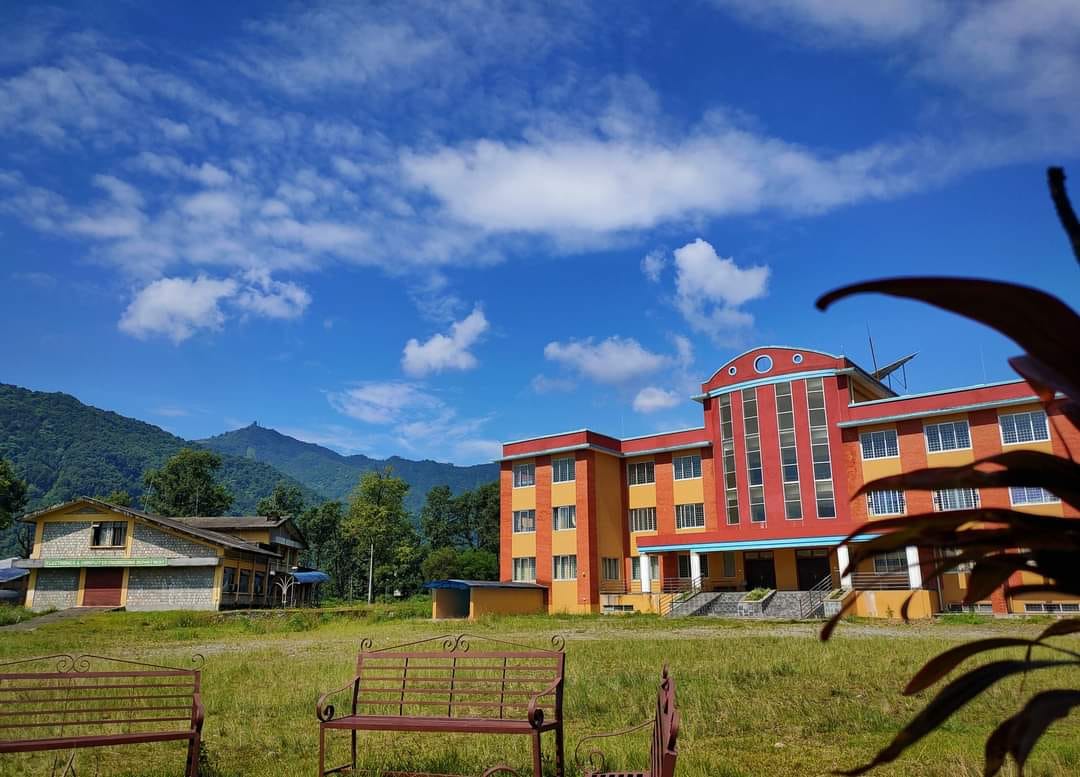
The campus was established with assistance from the World Bank and UNDP/ILO. It became operational in 2044 BS (1987 AD), initially offering trade, technician, and diploma-level programs.
Its academic scope later shifted toward university-level engineering education. Bachelor-level study began with Civil Engineering in the 1999/2000 academic period. Additional engineering programs were introduced gradually as the campus expanded.
Master's-level engineering education began in 2015. Postgraduate programs were subsequently developed in Communication and Knowledge Engineering, Infrastructure Engineering and Management, Distributed Generation, Rock and Tunnel Engineering, and Geospatial Engineering.
The institution has historically also been known as Western Region Campus, commonly abbreviated as WRC. The name remains associated with the campus, while Pashchimanchal Campus is used within the current Institute of Engineering structure.
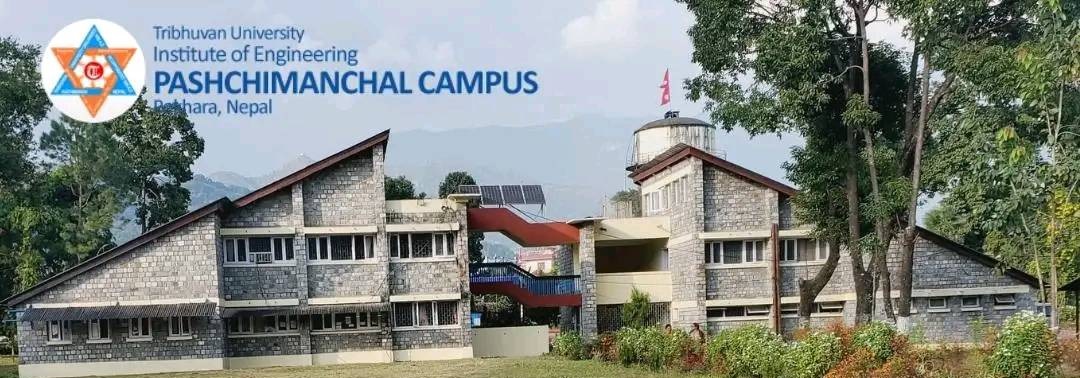
Pashchimanchal Campus is located at Lamachaur in Pokhara, Gandaki Province. Its location falls within Pokhara Metropolitan City.
The campus covers approximately 312 ropanis of land. The physical area accommodates academic buildings, laboratories, workshops, administrative offices, student facilities, hostels, staff accommodation, recreation areas, and other institutional functions.
The Seti River lies near the campus, and the surrounding landscape includes views toward the Annapurna range and Machhapuchchhre. These geographical features form part of the physical setting of the Lamachaur campus.
The size of the campus allows academic, residential, administrative, laboratory, workshop, and recreational facilities to operate within one institutional area.
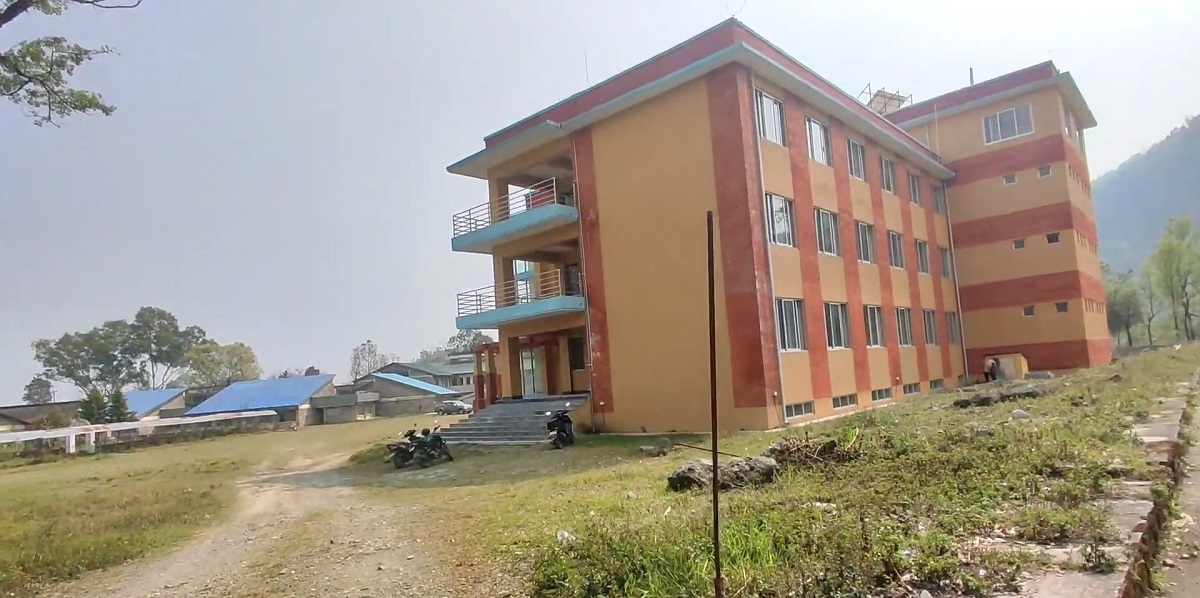
Pashchimanchal Campus functions as a constituent campus of the Institute of Engineering under Tribhuvan University.
The campus provides teaching, laboratories, academic supervision, departmental administration, student services, and other campus-level functions. The broader academic framework, however, is governed through Tribhuvan University and the Institute of Engineering.
The Institute of Engineering provides the academic system under which engineering programs are conducted. Curriculum, entrance procedures, academic regulations, examinations, and program requirements follow the applicable TU and IOE rules.
Tribhuvan University is the degree-awarding authority. Students complete their academic study at Pashchimanchal Campus, while the university degree is awarded through TU after fulfillment of the prescribed academic requirements.
Engineering education also operates within Nepal's professional and regulatory environment. The Nepal Engineering Council is the professional and regulatory body associated with engineering practice in Nepal.
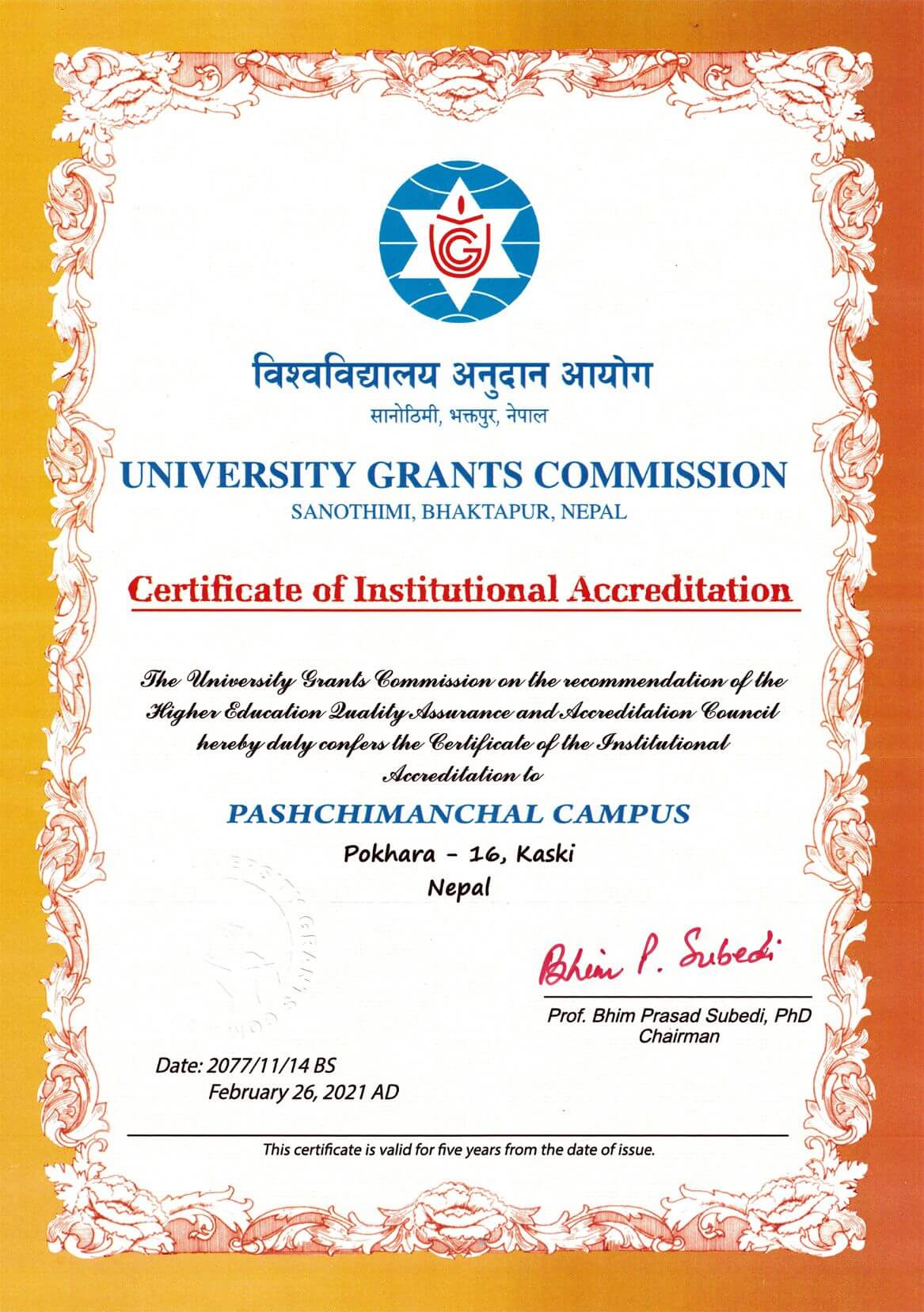
Pashchimanchal Campus received Quality Assurance and Accreditation certification from the University Grants Commission Nepal in 2021. The campus also maintains an Internal Quality Assurance Cell within its institutional structure.
Pashchimanchal Campus offers engineering programs at both bachelor and master's levels. The undergraduate portfolio contains seven engineering disciplines, while the postgraduate portfolio includes five specialized programs.
| Program | Level | Seats |
|---|---|---|
| Bachelor of Civil Engineering | Bachelor | 144 |
| Bachelor of Electrical Engineering | Bachelor | 48 |
| Bachelor of Electronics, Communication and Information Engineering | Bachelor | 48 |
| Bachelor in Computer Engineering | Bachelor | 48 |
| Bachelor in Geomatics Engineering | Bachelor | 48 |
| Bachelor in Mechanical Engineering | Bachelor | 48 |
| Bachelor in Automobile Engineering | Bachelor | 48 |
Civil Engineering has 144 seats. Each of the other six bachelor programs has 48 seats.
The undergraduate programs cover several branches of engineering. Civil Engineering focuses on infrastructure and related engineering systems. Electrical Engineering covers electrical systems and power-oriented study. Electronics, Communication and Information Engineering combines electronics, communication, and information-related areas.
Computer Engineering provides engineering education centered on computing systems. Geomatics Engineering relates to surveying, mapping, spatial information, and geospatial applications. Mechanical Engineering covers mechanical systems and related engineering subjects, while Automobile Engineering provides a specialized engineering pathway focused on vehicle and automobile systems.
| Program | Level | Seats |
|---|---|---|
| MSc in Communication and Knowledge Engineering | Master | 20 |
| MSc in Electrical Engineering in Distributed Generation | Master | 20 |
| MSc in Infrastructure Engineering and Management | Master | 20 |
| MSc in Rock and Tunnel Engineering | Master | 17 |
| MSc in Geospatial Engineering | Master | 20 |
The postgraduate programs extend the campus's academic scope into specialized areas of engineering.
Infrastructure Engineering and Management combines infrastructure-related engineering study with management components. Communication and Knowledge Engineering is connected with electronics, communication, computing, and information systems. Electrical Engineering in Distributed Generation focuses on electrical engineering within distributed generation systems.
Rock and Tunnel Engineering covers specialized study related to rock engineering and underground construction. Geospatial Engineering develops postgraduate study around spatial information and geospatial technologies.
The master's programs also include advanced academic work through projects, research, and thesis requirements under the applicable TU and IOE academic structure.
Pashchimanchal Campus organizes its academic activities through discipline-based departments. The main academic departments are:
The Department of Civil Engineering is connected with the campus's earliest expansion into bachelor-level engineering education.
Geomatics Engineering functions as a separate academic area because of its specialized requirements in surveying, spatial information, mapping, and related technologies.
The Department of Electronics and Computer Engineering brings together electronics, communication, information, and computer-related academic areas. Electrical Engineering operates through its own department, including the academic base associated with postgraduate work in distributed generation.
Mechanical and Automobile Engineering are organized within a combined department. Their teaching requirements include mechanical systems, machines, workshop-based learning, and vehicle-related engineering.
The Department of Applied Sciences supports engineering study through foundational areas such as mathematics, physics, chemistry, communication, and other subjects required in the engineering curriculum.
The campus also maintains research and academic units including the Centre for Space Science and Geomatics Studies and the Research Management Cell.
Admission to Pashchimanchal Campus follows the academic rules and regulations of Tribhuvan University and the Institute of Engineering. The campus does not operate an independent admission system outside the TU and IOE framework.
For bachelor-level engineering programs, applicants must satisfy the applicable academic eligibility requirements and participate in the IOE entrance process.
The general admission sequence includes:
The IOE entrance examination therefore forms part of the academic selection process for bachelor-level engineering admission.
Admission to master's programs also follows IOE graduate admission rules. Applicants must meet the academic eligibility applicable to the relevant postgraduate program and complete the prescribed entrance and selection process.
Eligibility may differ among postgraduate programs because each master's degree can require a particular prior engineering qualification or academic background. Requirements for Geospatial Engineering, Rock and Tunnel Engineering, Infrastructure Engineering and Management, Distributed Generation, and Communication and Knowledge Engineering therefore follow the respective TU and IOE program regulations.
Eligibility for study at Pashchimanchal Campus is governed by Tribhuvan University and the Institute of Engineering.
For bachelor-level engineering, applicants must satisfy the academic qualifications and entrance requirements prescribed for IOE engineering admission.
For master's programs, the required prior qualification depends on the field of study. The qualifying degree, academic standard, entrance requirement, and other admission conditions follow the applicable graduate program rules.
This makes postgraduate eligibility discipline-specific. Meeting the academic background for one master's program does not automatically establish eligibility for another.
Admission therefore depends on both academic eligibility and entrance-based selection where required under the IOE system.
The engineering curriculum at Pashchimanchal Campus operates under the academic authority of the Institute of Engineering and Tribhuvan University.
Bachelor of Engineering programs are structured as four-year university degrees divided into eight semesters. The academic structure combines foundational subjects, engineering sciences, discipline-specific courses, practical work, tutorials, laboratories, projects, electives, and other requirements prescribed in the relevant curriculum.
The early stages of engineering study establish foundations in mathematics, science, computing, drawing, communication, and introductory engineering subjects. Later semesters move progressively toward discipline-specific technical content.
The Bachelor of Civil Engineering curriculum, for example, includes Engineering Mathematics, Engineering Chemistry, Computer Programming, Basic Electrical and Electronics Engineering, Engineering Mechanics, Engineering Geology, surveying, structural subjects, fluid and hydraulic subjects, soil and foundation engineering, transportation, water-related subjects, engineering economics, design work, and other civil engineering components.
Each engineering degree follows its own TU and IOE curriculum.
Practical components form an integral part of engineering education. Depending on the program, students may complete laboratory work, engineering drawing, workshops, surveying, field activities, programming tasks, design exercises, projects, and other practical requirements.
At master's level, academic study moves into specialized coursework, electives, project activity, research, and thesis work according to the applicable curriculum.
Changes to curriculum, course codes, credit structure, examinations, and academic requirements remain governed through the responsible TU and IOE academic bodies.
Engineering examinations at Pashchimanchal Campus follow the Institute of Engineering examination framework.
Semester assessment combines the components prescribed for each course. Depending on the subject, these may include internal assessment, practical work, laboratory exercises, assignments, projects, field components, and final examinations.
Students must complete the academic and practical requirements specified in the curriculum.
At master's level, project and thesis components form part of postgraduate assessment. Thesis work requires students to complete academic or engineering research under the relevant program requirements.
After successful completion of the curriculum, examinations, practical components, project work, thesis requirements where applicable, and other academic conditions, the degree is awarded by Tribhuvan University.
Students therefore complete their studies at Pashchimanchal Campus within the Institute of Engineering academic system and receive the final university degree from Tribhuvan University.
Engineering study at the campus combines classroom instruction with practical and discipline-specific learning.
Lecture courses provide theoretical foundations, while tutorials support problem solving and technical calculations. Laboratory courses connect engineering principles with experimentation, testing, measurement, computing, and technical observation.
Workshop-based activities are particularly relevant to mechanical and automobile engineering. Electrical and electronics programs depend on practical work with electrical, electronic, communication, and related systems. Computer Engineering requires computing facilities, while Geomatics Engineering includes surveying and spatial-data activities.
Civil Engineering combines classroom study with practical work in areas such as surveying, structures, materials, soil, hydraulics, and design.
At postgraduate level, the emphasis becomes more specialized. Coursework is combined with technical analysis, research questions, project work, and thesis activity.
Pashchimanchal Campus maintains discipline-based laboratory and workshop facilities to support its engineering programs.
Laboratory and workshop provision serves Civil Engineering, Electronics and Communication Engineering, Computer Engineering, Electrical Engineering, Mechanical Engineering, Geomatics Engineering, and Automobile Engineering.
Academic facilities include:
Civil Engineering uses practical facilities for testing, measurement, and discipline-related laboratory work. Electronics, computer, and electrical programs use laboratories suited to their respective technical areas.
Mechanical and Automobile Engineering use workshop-based spaces, while Geomatics Engineering requires surveying, geospatial, and computing facilities.
The library supports engineering subjects together with mathematics, physics, chemistry, English, management, and other areas included in the curriculum.
The campus also has a Research and Innovation Center building with classroom, computer, administrative, multipurpose, and research-oriented spaces.
Pashchimanchal Campus includes residential and non-academic facilities alongside its academic infrastructure.
Separate hostel arrangements are available for male and female students. The campus area also contains staff accommodation and supporting residential facilities.
Student amenities include:
These facilities operate within the same campus area as classrooms, laboratories, workshops, library services, administrative offices, and research units.
Research activity at Pashchimanchal Campus is supported through academic departments and specialized institutional units.
The Research Management Cell was established in February 2010. Its activities include research grants, academic talks, conferences, workshops, publication-related work, and research coordination.
The campus is associated with the Journal of Engineering and Sciences, which began publication in 2022 and is indexed in NepJOL. Oodbodhan, connected with the Tribhuvan University Teachers' Association Pashchimanchal Campus Unit, has also been published as an academic journal and is indexed in NepJOL.
The campus participates in the IOE Graduate Conference framework, which provides a platform for graduate students to communicate research findings.
The Centre for Space Science and Geomatics Studies supports academic and research activities related to geomatics and spatial study.
Research at the campus includes student projects, master's theses, departmental activities, and faculty-led work.
The MSc in Rock and Tunnel Engineering has been associated with the NORHED II project and cooperation with the Department of Geoscience at the Norwegian University of Science and Technology.
This cooperation is related to capacity development in rock and tunnel engineering, including academic work connected with underground construction, geological conditions, and engineering involving rock masses.
The campus has also maintained memoranda of understanding and institutional relationships with academic, government, and engineering organizations. These relationships support areas such as research cooperation, technical interaction, institutional development, and academic exchange.
Pashchimanchal Campus operates through a campus administration headed by the Campus Chief. The structure includes assistant campus chiefs and administrative and finance responsibilities, while academic departments function under their respective departmental leadership.
The administration operates within the Tribhuvan University Act, TU rules and regulations, and the academic framework of the Institute of Engineering.
Institutional units include the Internal Quality Assurance Cell, Research Management Cell, consultancy functions, liaison activities, and specialized academic centers.
The campus received QAA certification from the University Grants Commission Nepal in 2021. Quality-related functions are also connected with academic planning, institutional review, research, student services, infrastructure, administration, and departmental work.
Engineering education at Pashchimanchal Campus includes practical learning that connects classroom study with technical applications.
The campus has developed institutional relationships with industry, government bodies, and engineering organizations through departments, liaison activities, and memoranda of understanding.
These relationships can support activities such as technical interaction, field exposure, research cooperation, industrial visits, professional discussions, and project work linked with the academic curriculum.
The programs themselves also contain practical components including laboratories, workshops, surveying, field activities, projects, and postgraduate research.
Professional practice after graduation remains separate from the university degree and follows the relevant professional and regulatory requirements in Nepal.
Pashchimanchal Campus brings several engineering disciplines together within one institution.
Civil Engineering interacts with surveying and geospatial information. Electrical Engineering shares areas of application with electronics, computing, and distributed energy. Mechanical and Automobile Engineering overlap in subjects related to machines, materials, manufacturing, and system design. Computer and electronics disciplines intersect in communication, information, and computing systems.
This multi-department academic structure also supports interdisciplinary project and research activity where technical problems involve more than one engineering field.
Undergraduate students follow structured professional engineering degrees, while master's students move into more specialized and research-oriented study.
Students considering Pashchimanchal Campus should first identify the engineering field that matches their academic preparation and area of interest.
The seven bachelor programs differ in subject content, practical requirements, and technical focus. Students applying to master's programs also need to consider the eligibility requirements attached to the particular postgraduate degree.
Important points for applicants include:
Students comparing engineering programs should therefore consider the relevant discipline, academic eligibility, curriculum, entrance requirements, practical components, and intended field of study.
Pashchimanchal Campus is a constituent campus of the Institute of Engineering under Tribhuvan University. Its engineering programs operate within the TU and IOE academic framework, and the degrees are awarded by Tribhuvan University.
The campus is located in Lamachaur, Pokhara, Gandaki Province, Nepal. It occupies approximately 312 ropanis of land used for academic, administrative, residential, laboratory, workshop, research, and recreational purposes.
Yes. Western Region Campus, commonly abbreviated as WRC, is the historical name associated with the institution.
The campus offers seven bachelor-level engineering programs: Civil Engineering; Electrical Engineering; Electronics, Communication and Information Engineering; Computer Engineering; Geomatics Engineering; Mechanical Engineering; and Automobile Engineering.
Bachelor of Civil Engineering has 144 seats. Each of the other six bachelor engineering programs has 48 seats.
The campus offers MSc programs in Communication and Knowledge Engineering, Electrical Engineering in Distributed Generation, Infrastructure Engineering and Management, Rock and Tunnel Engineering, and Geospatial Engineering.
Admission follows the rules and regulations of Tribhuvan University and the Institute of Engineering. Bachelor applicants must satisfy the applicable academic eligibility and IOE entrance requirements, while master's applicants follow the relevant IOE graduate eligibility and entrance process.
The engineering curriculum is governed through the Institute of Engineering under Tribhuvan University. Pashchimanchal Campus delivers the programs through its departments, laboratories, workshops, projects, and academic units.
Tribhuvan University awards the degree after students successfully complete the prescribed curriculum, examinations, practical requirements, projects, and thesis work where applicable.
Yes. Separate hostel facilities are available for male and female students.
Yes. Research activities are associated with the Research Management Cell, academic departments, postgraduate projects and theses, the Centre for Space Science and Geomatics Studies, academic publications, conferences, and institutional research cooperation.